
-
The Energy Transition in Jordan: Policy Lessons from ...
The Energy Transition in Jordan: Policy Lessons from Germany and the EU
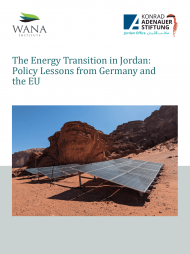
This paper addresses Jordan’s Economic Modernisation Vision (EMV) target of a reliable, sustainable, and interconnected energy sector. To do so, the paper identifies the constraints that limit Jordan’s energy transition and translates them into a reform package. Drawing on Jordanian legal documents, the paper classifies current regulations according to their impact on the energy transition as binding, partially binding, or enabling. Two constraints emerge as binding: connection regulations, which prevent viable solar projects from proceeding at scale, and the network services fee, which adds an additional monthly cost for renewables. Partially binding constraints include the electricity single-buyer model, absence of a renewable projects auction schedule, weak enforcement of energy efficiency obligations, and underdeveloped low-cost heat options. The paper applies a policy transfer approach, matching each constraint to specific instruments from Germany and the European Union (EU), assessing their design fit, and sequencing the recommendations into a three-phase roadmap. It complements this roadmap with a Key Performance Indicator (KPI) framework and cross-cutting risk mitigation and enabling measures. The paper’s main contribution is to provide a concrete and time-bound policy package that advances the energy transition. Adopting these measures will help achieve three key objectives of the EMV, namely, Sustainable Resources, Invest Jordan, and Green Jordan.
Please use the following citation text in your references:
Al-Quran, Sanad. “The Energy Transition in Jordan: Policy Lessons from Germany and the EU.” (Amman, Jordan: West Asia-North Africa Institute (WANA) and Konrad-Adenauer- Stiftung (KAS) – Jordan Office, 2026).