-
From Classroom to Community: Leveraging Social Studies ...
From Classroom to Community: Leveraging Social Studies Education for Long-Term and Inclusive Economic Growth
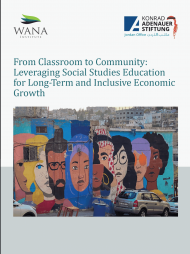
Jordan ranks in the bottom 20th percentile of countries globally on social capital indices, indicating low levels of interpersonal trust, civic engagement, and tolerance, which undermine Jordan’s Economic Modernisation Vision’s goal of inclusive economic growth and improved quality of life. Civic and social studies education plays an instrumental role in strengthening social capital by cultivating shared values of social tolerance and civic and social engagement (CSE) among young people. This paper examines the extent to which social tolerance and CSE are promoted in Jordan’s education ecosystem at the policy, institutional and interpersonal levels by analysing the General and Specific Framework for Social Studies, the national social studies curriculum, and data from focus group discussions conducted with social studies teachers across the Kingdom. The paper finds that although the new national social studies curriculum incorporates concepts of tolerance and CSE, insufficient teacher training, limited learning tools, and weak school infrastructure constrain its effective implementation. Addressing these gaps will strengthen Jordan’s social capital and help realise the broader ambitions of the EMV. Recommendations call for addressing gaps in the curriculum, establishing partnerships among stakeholders to promote tolerance and CSE among adolescents, and investing in teacher training and school infrastructure.
Please use the following citation text in your references:
Nasser, Salma. “From Classroom to Community: Leveraging Social Studies Education for Long-Term and Inclusive Economic Growth.” (Amman, Jordan: West Asia-North Africa Institute (WANA) and the Konrad-Adenauer- Stiftung (KAS) – Jordan Office, 2026).